
 |
MapGeo | Quarterly NewsletterMarch 2026 |
Hi there,This Quarter's MapGeo Community Spotlight |
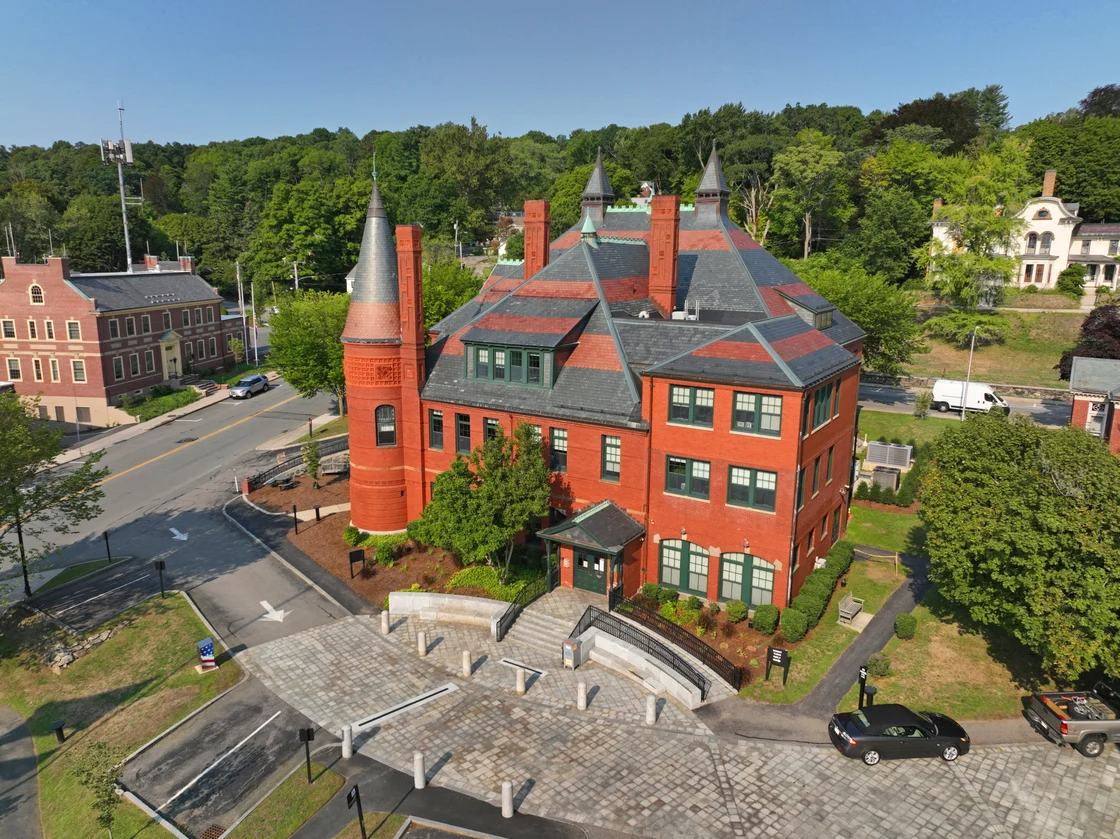 |
Built in 1881, Belmont Town Hall is an 18,800-square-foot, four-story brick building at Concord Avenue and Pleasant Street with High Victorian and Queen Anne architectural influences. |
A Clearer View of Belmont |
With Cambridge on its border and downtown Boston just a few miles away, The Town of Belmont, MA is much closer to the city than its quiet reputation suggests. The community features many homes from the 18th and early 19th century, including the grand country estate of John Perkins Cushing. John Cushing’s wish was that Belmont would carry on the name of his 200‑acre “Bellmont” estate when the community incorporated on March 18, 1859. These vintage homes now coexist with thoughtful construction, reflecting Belmont’s blend of heritage and progress.
Belmont’s commitment to thoughtful planning and public transparency is reflected through the recent addition of Sanborn’s MapGeo platform, which now serves as the town’s central gateway for parcel and land-use information. Residents, property owners, developers, and municipal staff can explore boundaries, zoning districts, ownership records, assessment data, and neighborhood context through a single interactive map rather than navigating multiple offices or static documents. |
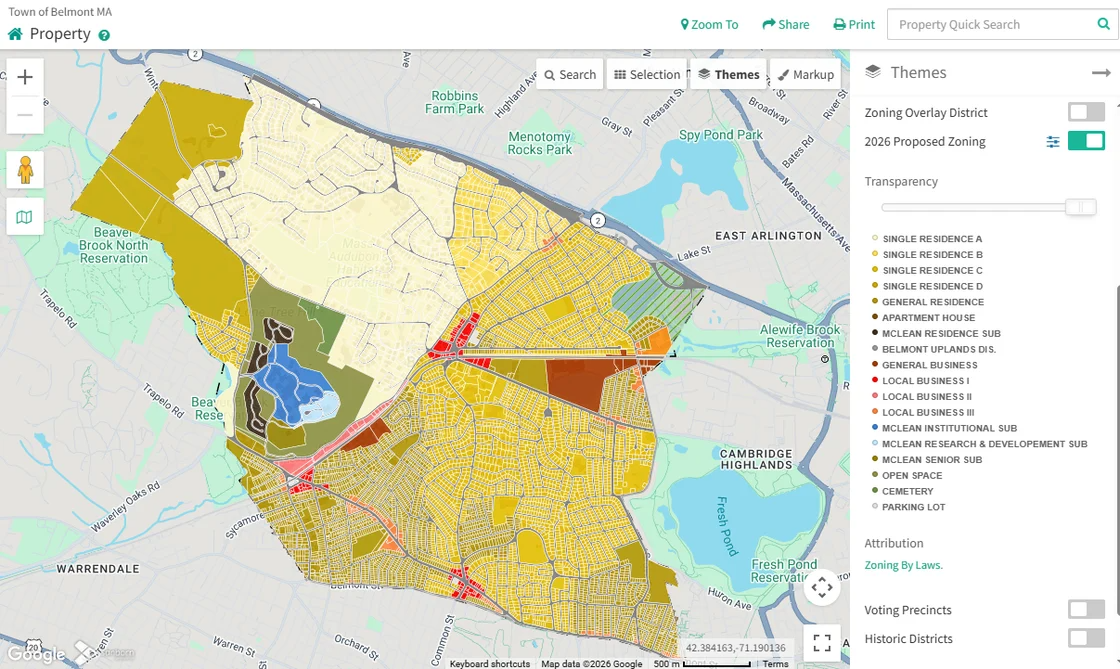 |
Belmont's 2026 Proposed Zoning theme turned on with a link to the Zoning Bylaws. |
Historic Sanborn Fire Insurance Maps |
For over a hundred and thirty years, The Sanborn Map Company was creating and maintaining fire insurance maps that were initially used for fire insurance underwriting. The Sanborn Maps provided the user with specific information such as address, building use, height, number of floors, and construction material for individual properties shown on the map. During its long and proud history, Sanborn created maps of approximately 12,000 communities throughout the US. Altogether, Sanborn has created over 1.5 million maps documenting the growth and development of US cities and towns. |
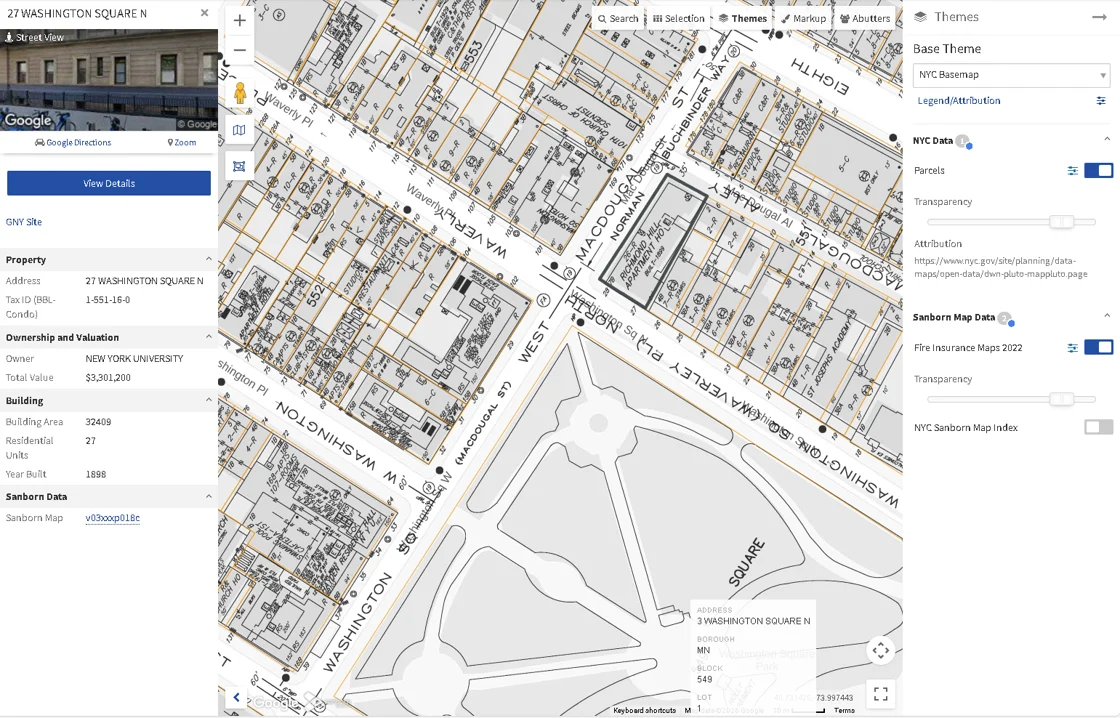 |
Sanborn's fire Insurance Maps integrated into MapGeo as a theme |
How MapGeo Seamlessly Integrates with 3rd Party Systems |
MapGeo is designed to connect your GIS with the other business systems your organization relies on every day. Through both in‑app integrations and flexible link‑based integrations, MapGeo can tie directly into permitting platforms, document management systems, and other operational tools your staff uses.
Municipalities across the country already leverage MapGeo to link parcel and location data to permitting systems such as CityView, Accela, PermitView, OpenGov, and ViewPoint Cloud enabling users to jump from a property on the map directly to the associated permits in a single click. This improves workflow efficiency and gives staff and residents a clearer understanding of property‑level activity.
|
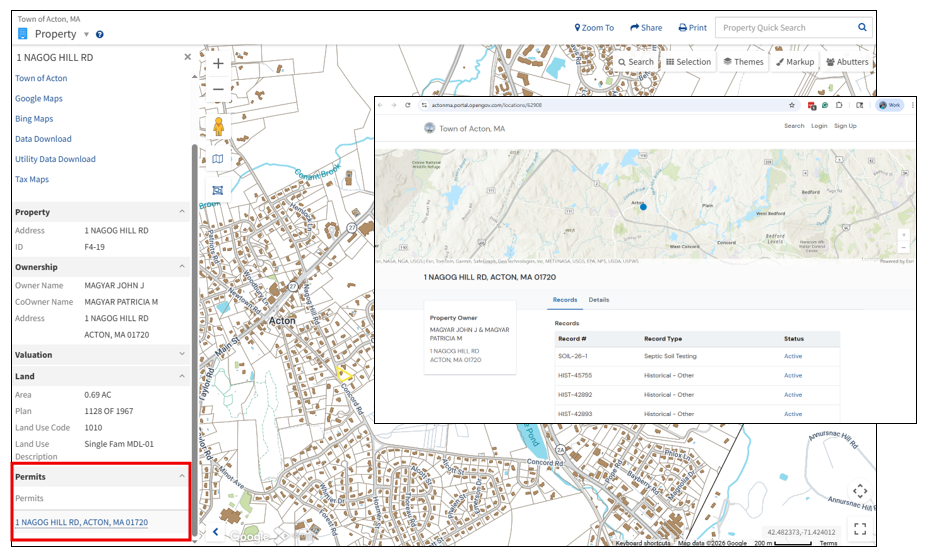 |
The Town of Acton, MA integrated OpenGov within MapGeo for internal staff. This integration allows staff to select a property in MapGeo and open a new tab to OpenGov with all the permits related to that property. |
For document management, MapGeo offers two powerful approaches: link‑outs to third‑party platforms such as Laserfiche or hosted documents linked to data attributes. Communities use these integrations to make thousands of documents; plans, as‑builts, permits, sketches, and more accessible directly through the mapping interface with just a click. There is no need to go into the Town Hall basement and waste valuable time trying to find the information you are looking for. |
SIQ Webinar - The Importance of GIS Data for Emergency Services |
In emergency management, location intelligence saves time and time saves lives. GIS provides the spatial context needed to plan, respond, and recover effectively during crises. From being able to accurately locate an emergency to improving emergency response times, GIS data empowers agencies to make fast, informed, and data driven decisions when it matters most.
During this session, we’ll highlight how key GIS datasets support emergency preparedness and response, including: |
Assessor Revaluation Support |
Municipalities can deliver a transparent, resident‑friendly revaluation experience through MapGeo. By integrating parcel data, CAMA information, and custom valuation layers, assessors can easily generate dynamic, interactive maps that clearly communicate how property values are determined. |
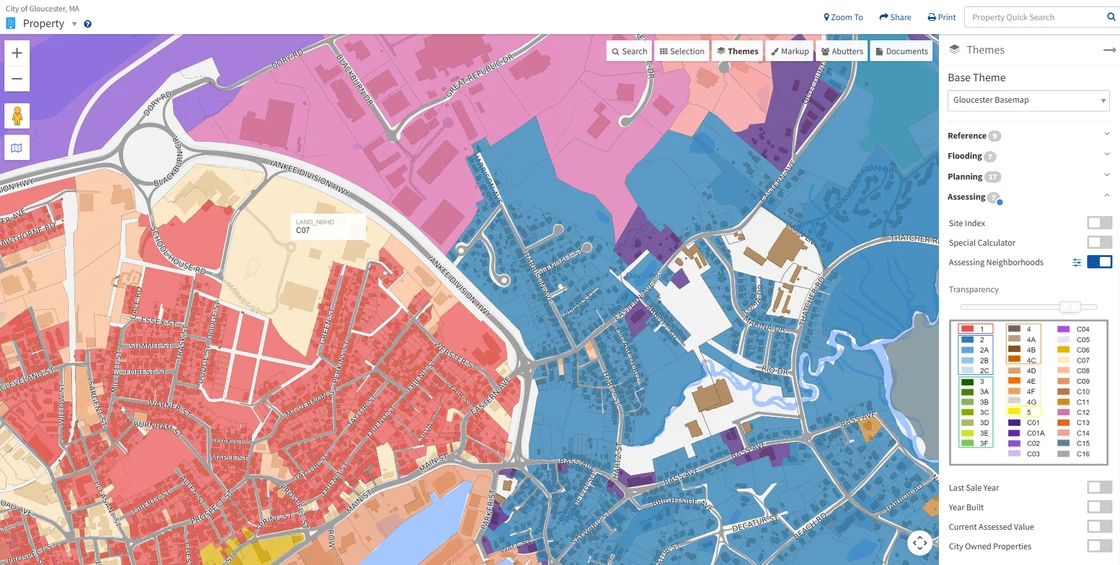 |
The City of Gloucester, MA displays their Assessing Neighborhoods on MapGeo to allow residents to compare like properties. |
In addition to the MapGeo interface, Sanborn can produce clear, accurate, and professionally designed digital PDF maps and other visuals to support the revaluation process. Digital PDF maps provide an accessible, printable resource for residents seeking clarity around neighborhood characteristics and valuation impacts. Sanborn has printed wall sized maps (4’x6’) for assessors to use during assessment hearings and public meetings during revaluation. Another alternative is an interactive dashboard which allows users to see the bigger picture, with more details than a PDF, to analyze the assessment data. An interactive digital dashboard has the ability to focus on property types like residential vs commercial or look at the difference between the current and previous revaluation and present changes to the data “on the fly”. |
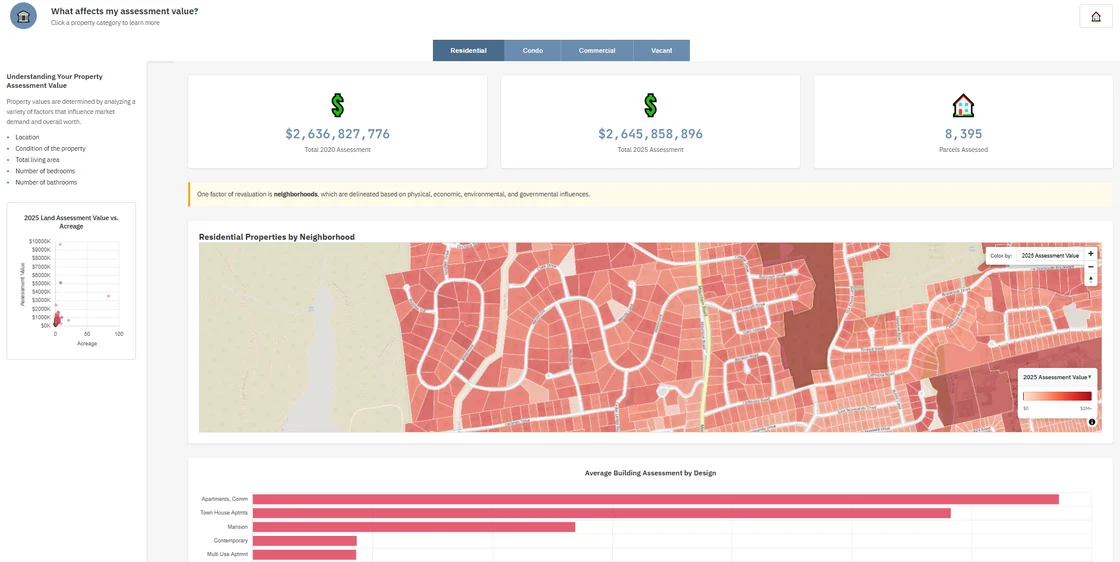 |
Sanborn created a dashboard for a municipality to support their revaluation process to disseminate residential and commercial property value data for residents. |
GIS Data Development and Special Project Support |
If your data has a spatial component, Sanborn can turn it into powerful, interactive GIS layers ready for use in MapGeo for both internal decision‑making and public transparency. Our team works with a wide variety of datasets and converts them into map‑ready formats, whether the goal is operational planning, community engagement, or infrastructure management. Organizations can take any location‑based data, such as park locations with detailed amenity attributes, critical infrastructure inventories, environmental features, utility assets, or permitting datasets and transform them into structured GIS layers that can be hosted, visualized, and maintained within MapGeo. |
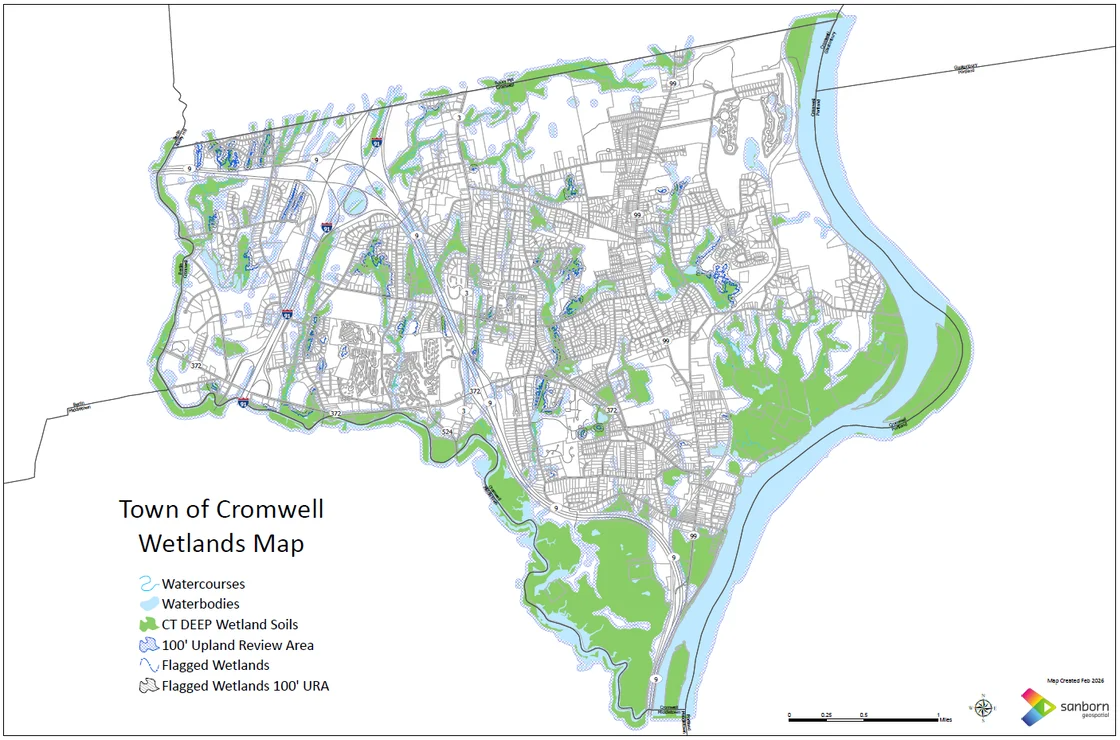 |
The Town of Cromwell, Connecticut recently requested a townwide wetlands map. Utilizing data from CT DEEP and digitized flagged wetlands from surveys to show wetland soils and the upland review areas to the wetlands |
Does your office have a street map from 5, 10, or even 15+ years ago that needs to be updated? Sanborn can update and print a new map for your space! Do those hanging tax maps or the zoning map on the wall need to be updated? Want other ideas on ways to grow your GIS? Check out our list of ideas in our support portal.
For more information or question please reach out to the support team! |
What's happening at Sanborn |
 |
Sanborn at GeoWeek 2026: A Decade of Leadership and Connection – The Sanborn Map Company was proud to once again have a strong presence on the GeoWeek show floor, continuing a tradition that now spans more than a decade. GeoWeek continues to stand out as one of the geospatial industry’s premier events, bringing together more than 3,200 professionals each year to explore the technologies and ideas shaping the future of mapping, remote sensing, and spatial intelligence. |
GeoWeek 2026 was particularly meaningful for Sanborn as our Chief Scientist, Dr. Srini Dharmapuri, was named a Fellow of the American Society for Photogrammetry and Remote Sensing (ASPRS)—the Society’s highest honor. This prestigious recognition highlights Dr. Dharmapuri’s exceptional leadership and lasting contributions to the geospatial profession and reflects the depth of expertise that drives Sanborn’s work every day. Thank you to everyone who stopped by our booth — we look forward to continuing these conversations and collaborations in the year ahead.
The Spatial IQ for MapGeo Team and the AppGeo Division at Sanborn
P.S. - Interested in having your city or county spotlighted in a MapGeo newsletter? Reply directly to this email to let us know. |
 |
|